LEADERSHIP / 2020-2023
Personalization Paths
Building Aki's Core Creative Offering Through Strategic Framework Design
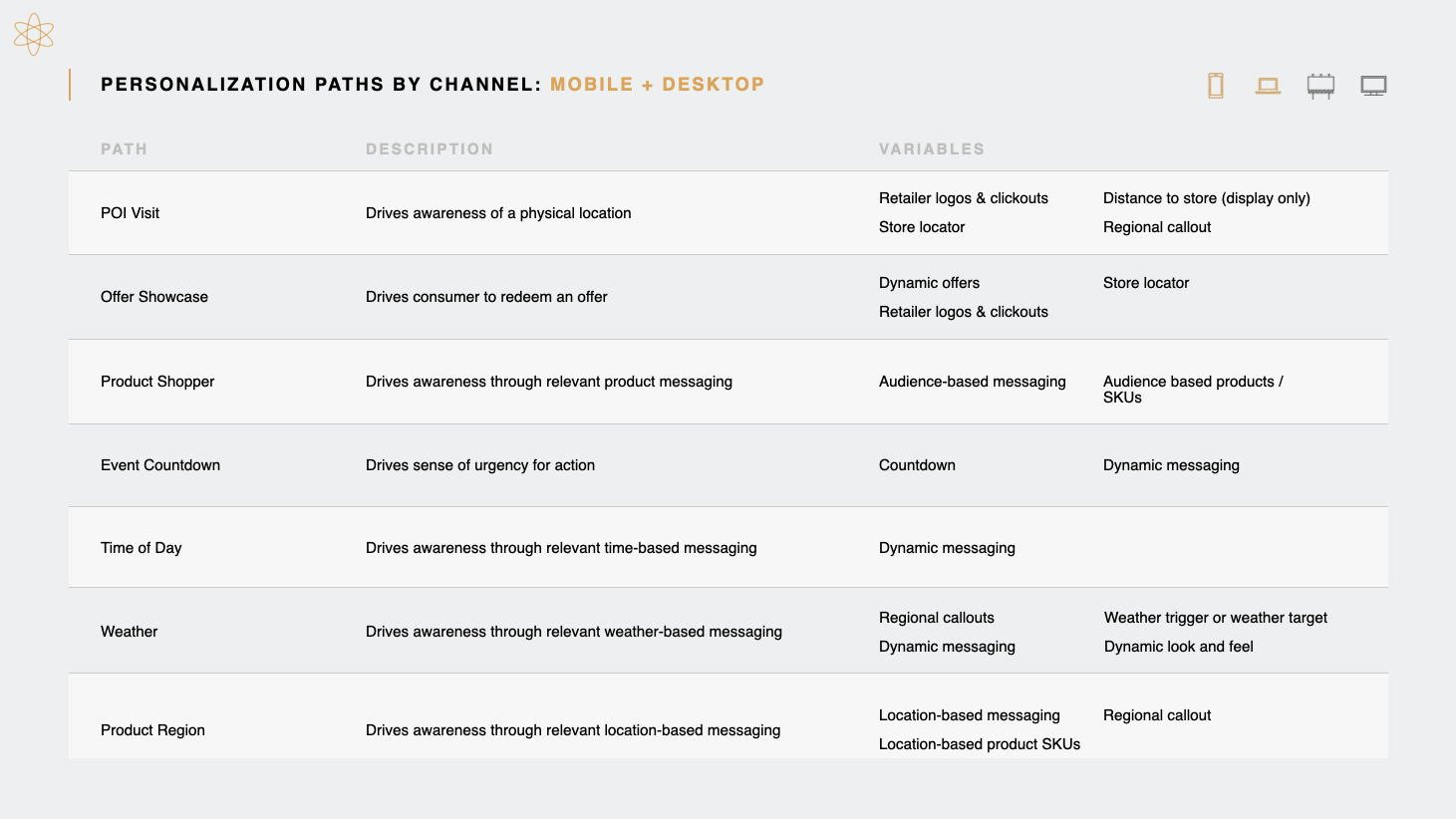
Before personalization became an industry expectation, Aki's ad-hoc creative variants transformed into Personalization Paths, a framework that became the company's core creative offering. A year-long campaign audit identified repeating patterns and turned them into standardized decision trees with dynamic feeds and templates. The result positioned Aki ahead of the market's shift toward "personalization as table stakes."
The Business Challenge
Before this work, Aki's approach to personalized creative was entirely reactive. A CPG brand would request geo-specific messaging and the team rebuilt creative for each market. A retailer would need offer lifecycle states and the team created equity, offer, and clipped variants from scratch. Every campaign meant custom strategy, bespoke builds, and extensive QA.
Three problems emerged:
1. Bottlenecks: Creative teams spent days rebuilding similar permutations for each campaign. No reusable templates existed.
2. Inconsistent Results: Without systematic strategy, performance varied wildly. Some campaigns saw strong lift from personalization, others showed minimal impact.
3. Market Risk: Competitors were starting to offer templated personalization as standard. We risked being seen as a premium "custom shop" that couldn't scale while the industry moved toward dynamic creative as table stakes.
My Approach: From Audit to Framework
The work started with an audit of 12 months of campaign history, examining every instance where the team had built creative variants for personalization. The catalog included variables like geography, retailer proximity, offer lifecycle states, time of day, weather conditions, audience intent, and product SKUs.
Geo + retailer appeared in dozens of campaigns. Offer lifecycle (Equity to Offer to Clipped) was nearly universal for incentive-heavy brands. Dayparting showed up consistently for QSR and CPG. Weather triggers worked for seasonal products. Repeating patterns emerged clearly.
Standardizing these patterns into reusable "Paths" could accelerate scoping, speed up execution with templates instead of net-new builds, improve consistency with proven approaches, enable better measurement with standardized KPIs, and create competitive differentiation.
"Personalization Path" emerged as campaign objective + signal set + feed specification + creative template + fallback rules + success metrics. This created a reusable decision framework and an operational system, not just a taxonomy.
Panel Participant: Celtra Creative Connect
I spoke about personalization on a Celtra Creative Connect panel at their NYC offices, sharing thoughts and insights on strategic personalization frameworks for a diverse audience of designers, developers, and marketers.
panel InsighT: Purposeful Personalization
A key insight that informed the Paths framework: It's okay to have a narrow scope for personalization. It's okay to speak to two audiences. It doesn't need to be this colossal multi-tier program.
Many marketers get excited with automation and want to personalize everything, leading to over-complexity, diluted messaging, and unclear ROI.
The Paths Approach: - Strategic Scoping: Use discretion to determine who you're talking to and why - Narrow Focus: It's okay to speak to two audiences rather than trying to personalize for everyone - Purpose-Driven: Each path has a clear objective (foot traffic, offer redemption, product awareness) - Right-Sized Solutions: Not every campaign needs a multi-tier program; sometimes a single path is the right answer
Paths were designed as reusable decision frameworks, not one-size-fits-all solutions. This strategic, selective approach differentiated Aki from competitors who offered "personalization for everything" without strategic thinking.
Productization & Go-to-Market
The critical transition was taking this internal framework and making it our client-facing offering. Working with sales leadership positioned Paths as our competitive differentiator.
Sales Enablement: One-pagers for each path family explained the approach, use cases, expected performance lift, and timeline. These became core assets in RFP responses and pitch decks.
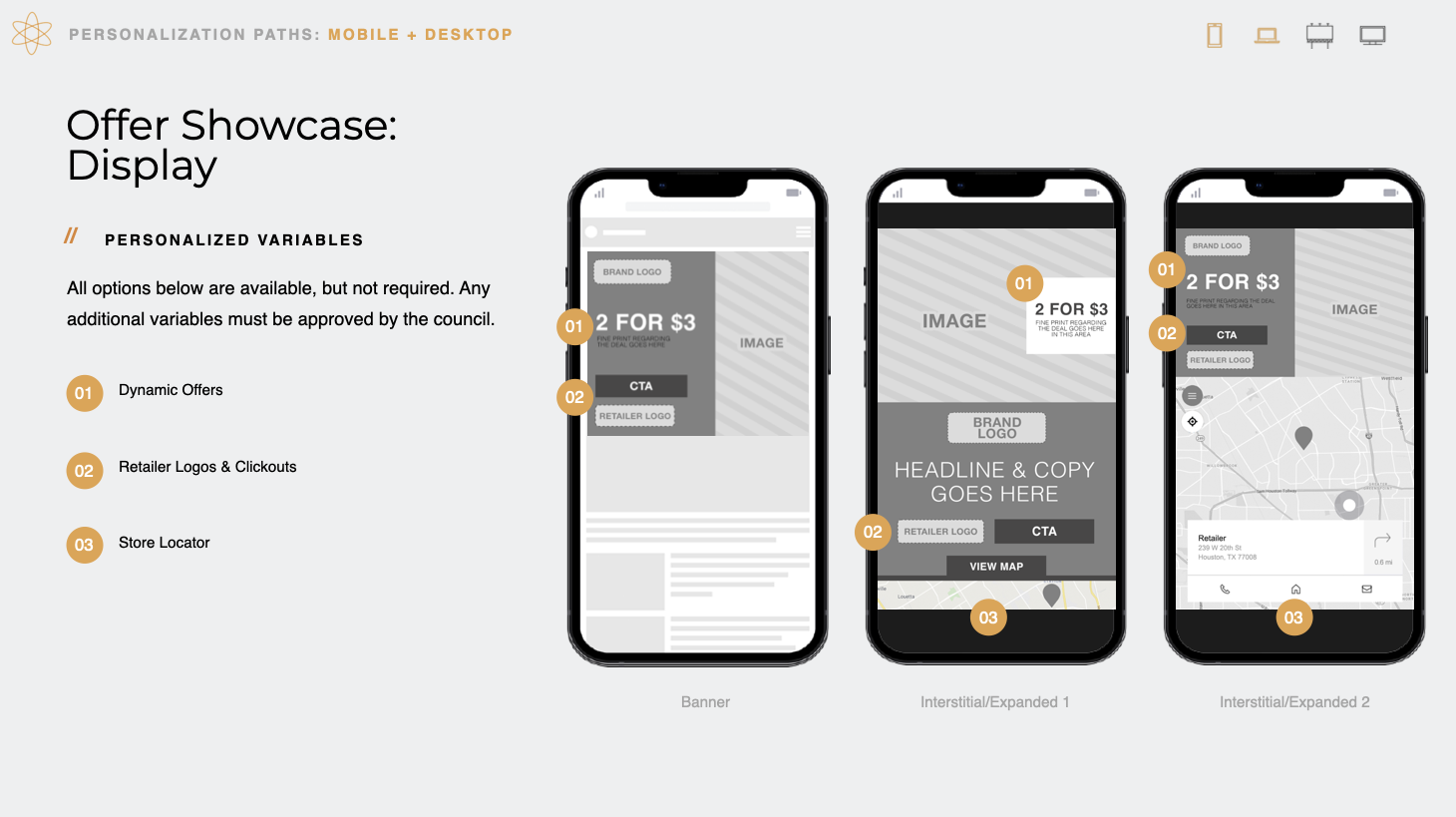
Client Presentations: Mockups showed generic creative versus path-based personalization with clear message differences. Demonstrations showed how a single path could remain tight in scope or scale to thousands of variants through feed automation.
Competitive Positioning: The approach was framed as "strategic personalization frameworks" versus competitors' DCO-centric approach. We brought proven approaches backed by performance data, not just more versions.
Pricing Integration: Paths pricing aligned with the Creative Calculator (my pricing/scoping tool covered in another case study), ensuring transparent scoping based on path complexity, feed size, and creative requirements.
Business Impact
The Personalization Paths framework delivered measurable impact across revenue, efficiency, and performance:
Revenue Impact
Core Offering
Became company's primary creative service model
Activation Portfolio
80%+ Campaigns
Implemented on over 80% of campaigns
Path Types
6+ Live
Offer, Product, Region, Time, Weather, Event path
Category Reach
Cross-Industry
Retail, CPG, pharma, QSR validated
Setup Efficiency
40-60% Faster
Campaign scoping and build time reduction
Strategic Foresight
Ahead of Market
Positioned before personalization became table stakes
Skills Demonstrated
Skills this project required:
- Pattern Recognition: Audited campaigns to identify repeating patterns that could be turned into revenue-generating offerings
- Framework Design: Turned ad-hoc practices into systematic framework, then into client-facing service that became the company's core offering
- Go-to-Market Strategy: Created positioning, sales enablement materials, competitive differentiation, and pricing alignment
- Product Ownership: Led from discovery to framework to productization to market adoption without formal product title
- Technical Specification: Defined feed schemas, rule logic, QA protocols, and operational guidelines for teams to execute
- Cross-Functional Leadership: Coordinated creative, ad ops, engineering, sales, and account teams to launch and scale
- Business Acumen: Identified market opportunity ahead of industry shift, positioned company as category leader
- Enablement: Built adoption through training, documentation, pilot validation, and ongoing support